key specifications
Mica
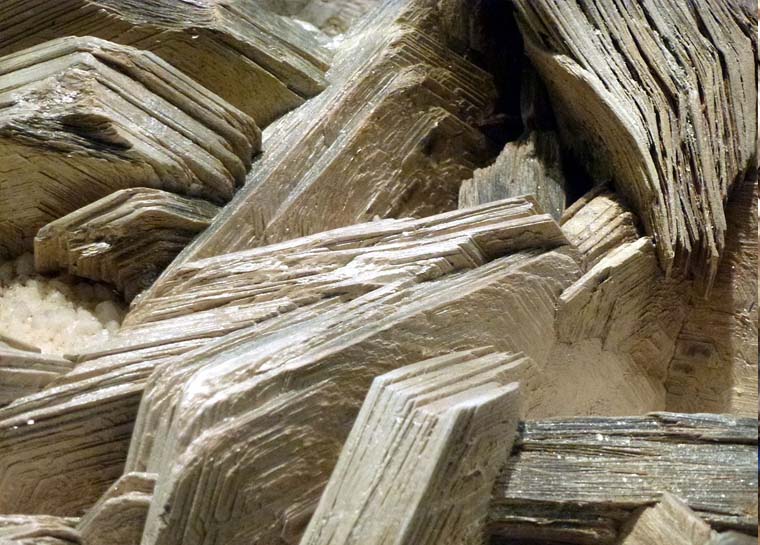
Mica is a general term for a group of alumina-silicate minerals. These minerals have a sheet-shaped structure and are composed of various physical and chemical compounds. Mica minerals are plate silicates that include muscovite, biotite, phlogopite, lipidolite and natronite.Muscovite is the most important and abundant plate mineral. Sheet muscovite is found in pegmatites and flakes in granite, pegmatites and schists. Lipedolite is formed in lithium-rich pegmatites. Phlogopite has been reported as streaks and masses in pyroxenites and magnesium-containing skarns.
Minerals of economic importance of Mica Group are classified as follows:
Muscovite: Potassium Mica (green or ruby) 3(H2KAl3(SiO4))
Biotite: Magnesium Iron Mica (dark color) (Mg, Fe)3Al(SiO4)3)(H2K)
Phlogopite: Magnesium Mica (yellow, dark brown) H2K(Mg)3Al(SiO4)3
Vermiculite: Juicy Biotite (bright yellow)
Lipidolite: Lithium Mica (pale yellow) (KLiAl(OH,F)2Al(SiO4)3
The crystal system of these minerals is mono-clinic. This group of minerals contains various compounds of aluminum silicate, iron, magnesium and mica. The presence of fluorine, barium, manganese, vanadium have also been reported in these minerals. Among these minerals, muscovite is widely used in industry due to its exceptional physical, chemical, thermal and mechanical properties. Vermiculite and phlogopite are just as important as mica. Biotite is rarely used in industrial applications.
Mineralogically, the minerals of the mica group are divided into three groups, which are:
The main group is mica, the group of brittle mica and the group of chlorite. All minerals in these groups have a mono-clinic structure. The structure of mica is a combination of two layers of tetrahedral silica and one layer of central octahedral.